
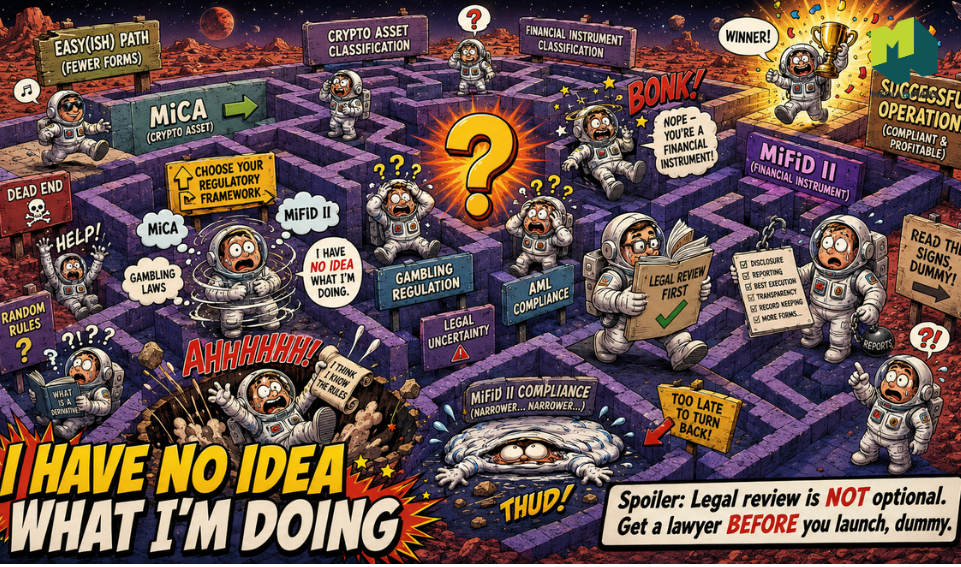
While Europe offers a major opportunity for companies operating prediction markets, it also presents one of the largest regulatory issues faced by the sector. Most operators entering the market start with the belief that they can use the existing crypto regulations and then discover that their business model meets the criteria for a financial services business.
MiFID II vs MiCA is one of the main factors in determining how a prediction market is regulated. Understanding the distinctions between both frameworks is essential for any company looking to enter the European market.
Understanding the Regulatory Landscape
A prediction market allows users to wager on the result of an event that happens in the future, such as an election, the outcome of a sporting event, or a change in economic conditions. Even though prediction markets may seem similar to betting and gambling, some prediction markets are classified as financial instruments by regulators.
This is where prediction markets regulation Europe becomes complicated.
Within the European Union, there are many possible regulatory frameworks that may affect an operator’s ability to operate, depending on how a platform is set up:
MiCA (Markets in Crypto Assets)
MiFID II (Market in Financial Instruments Directive)
National gambling regulations
Consumer protection and anti-money laundering laws
The challenge for prediction market operators is to determine which regulatory framework applies to them before they start operations.
The MiFID II vs MiCA Problem
MiFID II is not simply a choice between one licence and another.
MiCA regulates crypto-assets and crypto-asset service providers. MiCA regulates token issuance, custody and trading of crypto-assets and investors’ protection in the cryptocurrency ecosystem.
MiFID II, on the other hand, is the regulation of financial instruments such as securities, derivatives and investment products.
If a prediction market contract is treated as a derivative, or as an investment instrument and not as a crypto asset, the regulator may require the operator to comply with MiFID II, rather than MiCA.
The majority of operators make significant mistakes in this area.
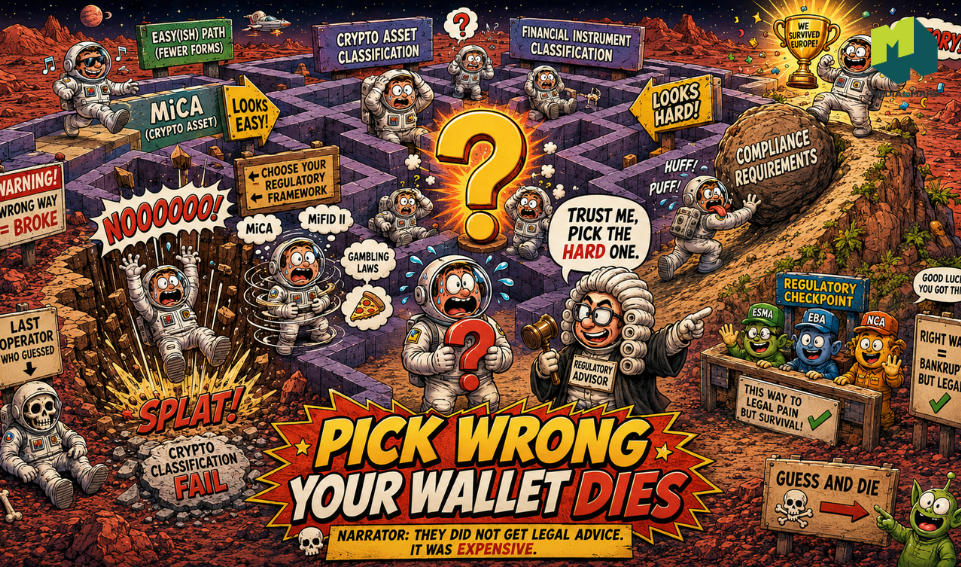
Why Operators Fail
Operators often underestimate the complexities of EU Prediction Market Compliance, which can lead to large amounts of unnecessary costs. Common mistakes include:
Assuming that a crypto token will automatically be classified as a MiCA compliant crypto asset.
Launching a product without getting a legal opinion on how that product will be classified.
Not looking at how regulators in each country may interpret the product.
Treating a prediction contract as a gaming product, when the regulators may consider it a financial product.
Mistakes such as these will lead to costly enforcement actions, operational restrictions and high legal costs.
Building a Compliant Strategy
Successful operators are compliant from the outset. A good approach includes:
Conducting a detailed legal review prior to launch.
Reviewing how prediction market contracts are constructed and settled.
Seeking expert advice on EU Prediction Market licensing Europe.
Keeping track of regulatory developments across different jurisdictions in the EU.
As the regulators refine their approach to regulating prediction markets, being compliant with MiCA Compliance for prediction markets may not be enough on its own if the product is ultimately determined to be subject to the financial services regime.
Conclusion
The main challenge facing prediction market platforms operating in Europe is regulatory classification, not technology challenges or acquiring users.
The continued debate over whether MiFID II applies versus whether MiCA will apply to prediction markets continues to impact how various regulators view prediction markets in Europe as a whole. Those who do not understand Prediction Market Regulation Europe could face expensive compliance penalties, compared to those who pursue EU Prediction Market Compliance and develop a sound strategy for obtaining the appropriate Prediction Market Licensing Europe will be much better positioned for success over the long term.