
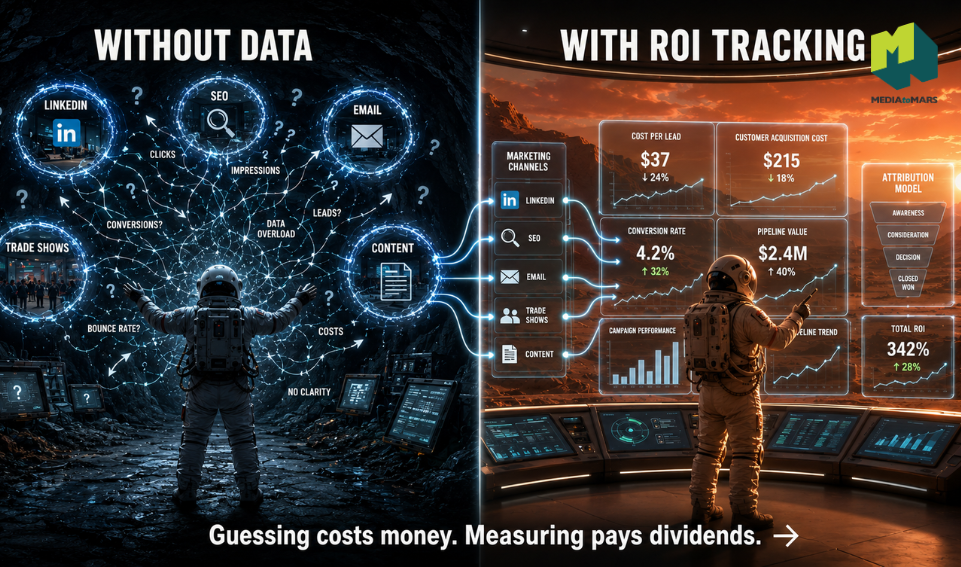
By 2026, the number of marketing channels available to B2B iGaming companies will continue to expand. There are numerous options available today including SEO, content marketing, trade shows, LinkedIn ads and e-mail campaigns; as such, iGaming companies are spending an increasing amount of money pushing their own brands in the hope of attracting operators, affiliates and partners. The only question is whether or not your marketing is actually generating revenue for your iGaming Company.
This is where marketing ROI plays an important role.
Having the ability to track your marketing's return on investment will allow you to identify which marketing efforts are truly generating results, and which are simply wasting budget dollars. With the use of marketing analytics, you will no longer have to rely on guesswork; rather, you will be able to use data that will allow you to make smarter decisions while improving on your performance over time.
Why Marketing ROI Matters
A strong marketing ROI strategy will provide iGaming brands with multiple benefits including:
The ability to identify the campaigns that are truly producing results and the campaigns that are performing poorly
Improved budget allocation to high-performing campaigns
Higher quality of leads generated from marketing
Increased profitability over the long term
In an increasingly competitive B2B market, measuring your results is no longer a "nice to have," rather it's a necessity. If you are unable to effectively measure your performance, you will struggle to grow efficiently.
Key Metrics to Track in 2026
Measuring your marketing ROI will begin with the ability to track the right metrics. The following are some of the main B2B marketing metrics that should be measured:

Using Marketing Analytics for Better Decisions
Modern B2B marketing analytics allow marketers to connect the dots between campaign activity to revenue earned for their company. If a lead comes from an industry event, an SEO article, a LinkedIn advertisement, or an email campaign; you will be able to see their path through the various stages of the sales funnel, until a conversion occurs.
You can improve the way you track your marketing by taking the following steps:
Connect your customer relationship management (CRM) system and your marketing software.
Use attribution models to understand the sources of your leads.
Track the performance of your marketing campaigns on at least a monthly basis.
Don't just track leads. Make sure you're also tracking revenue from those leads.
Many businesses focus on generating as many leads as possible. However, the ROI of lead generation is much more valuable, because it shows whether or not the leads generated actually created revenue.
The Formula for Marketing ROI
A simple formula for calculating ROI from marketing is:
ROI = (Revenue Generated - Expense of Marketing) / Expense of Marketing \* 100
Using this formula, if a company spends $10,000 on a marketing campaign and earns $50,000 in revenue from that campaign, they calculate:
ROI = (50,000 - 10,000) / 10,000 \* 100 = 400%
Meaning that for every dollar they spent, they received $4 back.
Conclusion
Due to the increase in competition in B2B iGaming, data-driven decision-making will play a significant role in creating a competitive advantage in 2026 and beyond. Q1 businesses will have a solid plan to track the right B2B marketing metrics, use advanced marketing analytics, and quantitatively measure ROI on their marketing expenditures so they can confidently use channels that produce revenue for their business.
FAQs
1. How to measure B2B marketing ROI?
Businesses should be comparing the revenue generated by their marketing initiatives against the total marketing costs to measure B2B marketing ROI. Businesses should track the number of leads generated, the number of conversions made from those leads, the average cost of acquiring a customer, and how many dollars of revenue from attributed to the account (company) using the lead. These four metrics should provide a complete view of how well B2B marketing efforts are performing.
2. What is the 95 5 rule in B2B marketing?
According to the 95-5 rule, just about 5% of all possible B2B customers are currently in the purchase process, while about 95% of buyers have yet to be ready to buy. Therefore, businesses should spend equal time creating their brands and generating leads.
3. What is the B2B SEO strategy for 2026?
A successful B2B SEO plan for 2026 will revolve around these areas: topical authority; good writing; user intent; AI-powered search visibility; thought leadership; and recurring optimisation related to relevant keywords, customer pain points, etc.